Best practice in mental health care for trans, gender diverse and non-binary people in Australia
The standards, guidelines and laws that shape good psychological care for trans, gender diverse and non-binary people in Australia, and what they mean in practice.
tl;dr
At a glance.
- Good TGDNB mental health care is good care, done carefully. We are not gatekeepers.
- WPATH SOC8 says therapy should not be a requirement for medical treatment, and one assessment is usually enough for surgery.
- Adults in Australia usually start hormones through a GP under AusPATH’s informed consent standards, with no letter needed.
- Psychologists must follow the Psychology Board’s Code of Conduct, and conversion practices are illegal in Victoria.
- Trauma, neurodivergence and eating concerns are more common for TGDNB people, and often masked, so we offer screening to everyone.
Good mental health care for trans, gender diverse and non-binary (TGDNB) people isn't a niche skill. It's good care, done carefully. Here is the framework we work to at The Liminal Clinic, and what each part means in practice. It is written for clients and for other health professionals.
The core international standard
The World Professional Association for Transgender Health's Standards of Care, version 8 (SOC8, Coleman et al., 2022) is the main international reference. For adults, it moved away from gatekeeping and towards informed consent. It says psychotherapy should not be a requirement for gender-affirming medical treatment, and that one assessment from one qualified professional is usually enough for surgery.
Australian standards
- AusPATH's Australian Standards of Care for Informed Consent: Gender Affirming Hormone Therapy (updated April 2026). Adults in Australia do not need a psychologist's letter, a WPATH assessment or a psychiatrist to start hormones. Most start through a GP, and some GPs focus on trans health.
- The Australian Psychological Society position statement on supporting the mental health and wellbeing of transgender and gender diverse people.
- The Australian Government's National action plan for the health and wellbeing of LGBTIQA+ people 2025 to 2035.
- Rainbow Tick standards for LGBTIQ cultural safety, from Rainbow Health Australia.
Professional obligations
Every registered psychologist in Australia must meet the Psychology Board of Australia's Code of Conduct, which took effect on 1 December 2025. For TGDNB clients, the parts that matter most are informed consent, cultural safety and culturally reflective practice, effective communication, and access to services free from unlawful discrimination.
The law
Change or suppression (conversion) practices are banned in Victoria, New South Wales, the ACT and South Australia, and in health settings in Queensland. In Victoria this is the Change or Suppression (Conversion) Practices Prohibition Act 2021. Supporting someone who is questioning, pausing or changing direction is not a conversion practice, as long as the clinician follows the person rather than steering them.
Discrimination law, including the Sex Discrimination Act 1984 and Victoria's Equal Opportunity Act 2010, covers gender identity and intersex status.
Caring for the whole person
TGDNB people bring the same things to therapy as anyone else, and some things more often. In Australia, 81.5% of gender diverse people have experienced child maltreatment, compared with 62.0% overall (Higgins et al., 2024), and 17.5% currently have PTSD, compared with about 5% of cisgender people (Madzoska et al., 2024). Trans and gender diverse people are 3 to 6 times more likely to be autistic (Warrier et al., 2020). In a national survey of trans Australian adults, 15% reported an autism diagnosis and 11% ADHD (Bretherton et al., 2021). And 23% of trans young people have had an eating disorder diagnosis (Strauss et al., 2017).
These are also often masked. Gender diverse autistic adults report more camouflaging on some measures, and people who camouflage more are diagnosed later (McQuaid et al., 2022). Restrictive eating can be a way to change body shape to affirm gender, and is easily missed by screening tools built around cisgender women (McGregor et al., 2023). Trauma may only come up once trust is built. Autistic TGD adults also report more difficulty understanding health professionals, knowing what to expect and describing pain (Green et al., 2025), which is why neurodiversity-affirming adjustments matter. That is why we offer every client screening for trauma, neurodivergence, and eating and body image, following Australian guidance:
- Trauma: Phoenix Australia's PTSD guidelines and the Blue Knot Foundation's complex trauma guidelines. Harm that happens because of who someone is counts as trauma, and is treated as such.
- Neurodivergence: the Autism CRC national guideline and the AADPA ADHD guideline. Trans and gender diverse people are more likely to be autistic (Warrier et al., 2020). Being neurodivergent does not make anyone less able to know their gender.
- Eating and body image: the National Eating Disorders Collaboration, which recognises LGBTQIA+ people as a priority population.
What this looks like in the room
- Names and pronouns used everywhere, including records and letters.
- No education burden: clinicians learn the basics themselves.
- No narrowing: there is no single trans story, and non-binary people are equally valid.
- No over-focus or avoidance: gender is talked about when it's relevant, not made the headline of every session.
- Minority stress named and worked with, not treated as a personal weakness.
- Wrap-around support over the medium to long term, never as a requirement for treatment.
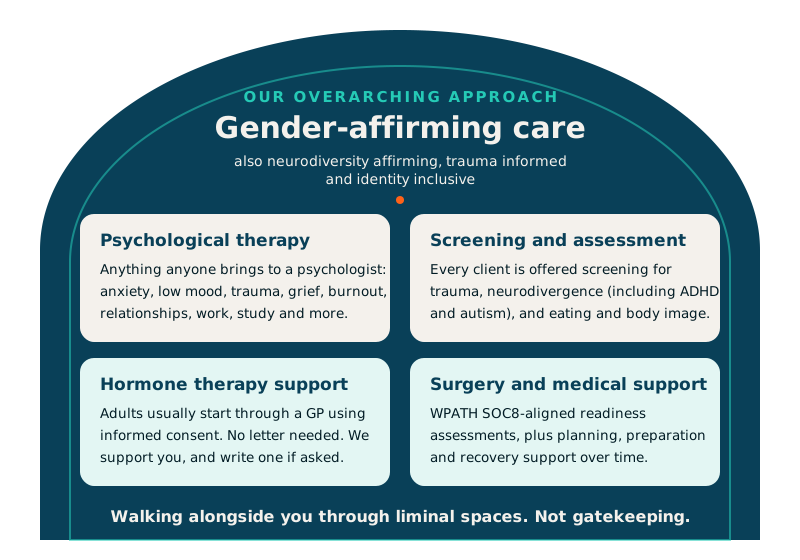
At The Liminal Clinic, our care is gender affirming and neurodiversity affirming, trauma informed and identity inclusive. We walk alongside people through liminal spaces. We are not gatekeepers.
Read more on our gender-affirming care page, or look up any term in our glossary.
References
- Australian Professional Association for Trans Health. (2026). Australian standards of care for informed consent: Gender affirming hormone therapy. https://auspath.org.au/standards-of-care/
- Coleman, E., et al. (2022). Standards of care for the health of transgender and gender diverse people, version 8. International Journal of Transgender Health, 23(S1). https://doi.org/10.1080/26895269.2022.2100644
- Psychology Board of Australia. (2025). Code of conduct. https://www.psychologyboard.gov.au/Standards-and-Guidelines/Professional-practice-standards/Code-of-conduct.aspx
- Bretherton, I., Thrower, E., Zwickl, S., et al. (2021). The health and well-being of transgender Australians: A national community survey. LGBT Health, 8(1), 42 to 49. https://doi.org/10.1089/lgbt.2020.0178
- Green et al. (2025). Autistic and transgender/gender diverse people's experiences of health and healthcare. Molecular Autism, 16, 4. https://doi.org/10.1186/s13229-024-00634-0
- Higgins, D. J., Lawrence, D., Haslam, D. M., et al. (2024). Prevalence of diverse genders and sexualities in Australia and associations with five forms of child maltreatment and multi-type maltreatment. Child Maltreatment. https://doi.org/10.1177/10775595231226331
- Madzoska, M., Lawrence, D., Higgins, D. J., et al. (2024). Child maltreatment, mental health disorders, and health risk behaviors in people with diverse gender identities. Journal of Interpersonal Violence, 40(9-10). https://doi.org/10.1177/08862605241270077
- McGregor, K., McKenna, J. L., Barrera, E. P., et al. (2023). Disordered eating and considerations for the transgender community. Journal of Eating Disorders, 11, 75. https://doi.org/10.1186/s40337-023-00793-0
- McQuaid, G. A., Lee, N. R., and Wallace, G. L. (2022). Camouflaging in autism spectrum disorder: Examining the roles of sex, gender identity, and diagnostic timing. Autism, 26(2), 552 to 559. https://doi.org/10.1177/13623613211042131
- Strauss, P., Cook, A., Winter, S., et al. (2017). Trans Pathways: The mental health experiences and care pathways of trans young people. Telethon Kids Institute.
- Warrier, V., et al. (2020). Elevated rates of autism in transgender and gender-diverse individuals. Nature Communications, 11, 3959. https://doi.org/10.1038/s41467-020-17794-1
Questions
Quick questions.
Do I have to talk about gender in therapy here?
No. You can bring anything, and gender only comes up if you want it to.
Will you decide whether I can have hormones or surgery?
No. We are not gatekeepers. For hormones, most adults don’t need us at all. For surgery, we do the assessment the standards ask for, and you read the report first.
I am a health professional. Can I refer to you?
Yes. See our information for referrers.
Nothing in this group for you. Try another tab, or show all questions.
Free guides and fact sheets.
Our client guides explain gender-affirming care and surgery readiness assessments step by step. There are also fact sheets for GPs, surgeons and other health professionals.
More from the blog
Keep reading.
Get new posts by email
One email when we publish something new. No marketing, and you can unsubscribe any time. See our Privacy Policy.
Your email address